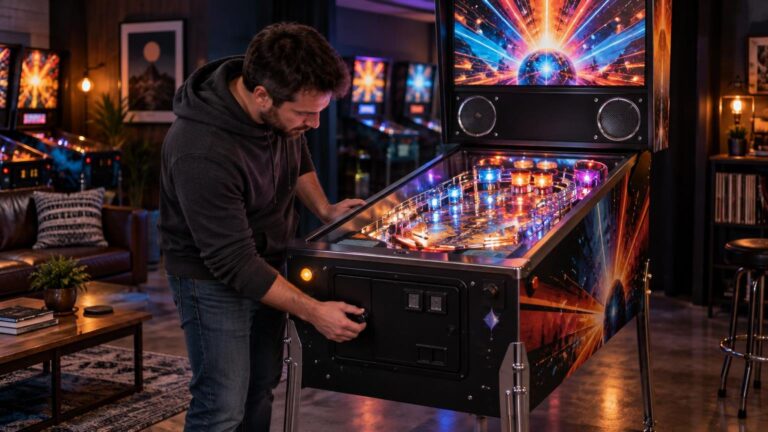
What Does a Shaker Motor Add to a Pinball Machine?
TLDR: What does a shaker motor add to a pinball machine? It adds game-controlled vibration that lets you feel selected events through the cabinet. A well-used shaker can give impacts, launches, warnings and major moments more physical weight, but it does not add shots, rules, scoring depth or ball-control ability. Treat it as an immersion upgrade, and buy one only after confirming that the exact machine, edition and hardware support it.
The practical distinction is simple: a shaker motor changes how a game feels, not what the game asks you to do. That can make it one of the most satisfying accessories for a compatible machine—or an unnecessary source of vibration and mechanical sound if you prefer a quieter cabinet.
What a pinball shaker motor actually does
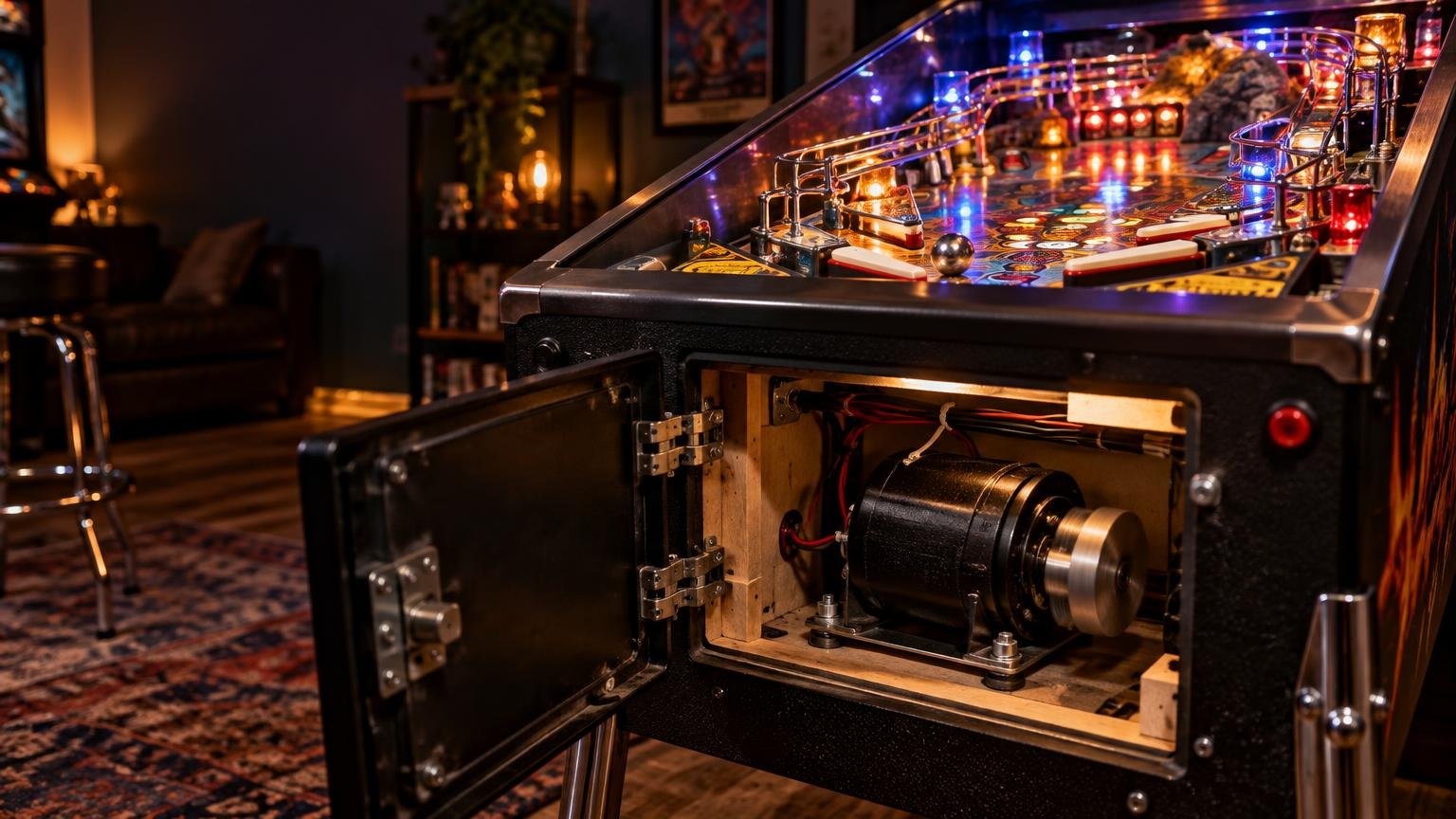
A shaker is a motor-driven assembly mounted inside the cabinet. The assembly uses weights attached to the motor so that rotation produces vibration rather than smooth, silent motion. Stern documentation depicts a system containing the motor, weights, mounting parts, an insulator, cover hardware and related electronics.
When supported game code activates the motor, that vibration travels through the cabinet and into the lockdown bar, side rails and other surfaces touching the player. The effect is closer to a controlled rumble than to a playfield mechanism striking the ball.
The game determines when that rumble occurs. Depending on the title and its software, a designer might use it to reinforce a crash, explosion, vehicle movement, launch, warning or major mode event. Those are examples of possible uses, not a universal trigger list. Frequency, duration and intensity can vary substantially from one title to another.
Shakers are not limited to one era of pinball. The Internet Pinball Database entry for Red & Ted’s Road Show identifies a shaker motor among that Williams machine’s features and dates its manufacture to October 1994. Modern manufacturers also continue to use shaker hardware, although inclusion can differ between editions. Stern’s James Bond 007 feature matrix, for example, lists a shaker motor as installed equipment on specified configurations rather than presenting it as identical across every version.
What does a shaker motor add to a pinball machine during play?
Its biggest contribution is tactile punctuation. Pinball already communicates through moving mechanisms, lights, music, speech and display animation. A shaker adds another channel: the cabinet itself reacts. When the timing suits the event, a moment can feel larger without requiring another toy on the playfield.
That physical response can also make a theme feel more convincing. A vehicle-themed game can suggest engine movement, while an action game can give an impact more force. The useful part is not vibration for its own sake. It is the connection between an event you see or hear and a response you feel at the same instant.
Implementation matters more than the mere presence of the motor. A shaker that fires selectively can emphasize important moments. One that runs too often may stop feeling special or may compete with the machine’s sound and mechanical action. Because activation is controlled by the individual game, the accessory’s value cannot be judged from the hardware alone.
Software can also evolve on modern machines, which is one reason it is worth checking the current code and title-specific notes rather than relying on an old gameplay video. Our explanation of why modern pinball machines receive code updates covers the broader relationship between machine software and supported behavior.
What a shaker motor does not change
A shaker motor is not a gameplay expansion. Installing one does not automatically add modes, increase scoring opportunities, alter shot geometry or improve the player’s control of the ball. If a machine’s rules feel shallow to you, a shaker will not make them deeper.
It is also different from nudging. Nudging is a physical input from the player: you move the cabinet to influence the ball while staying within the game’s tilt limits. A shaker is an output from the machine. The game activates it to provide feedback, and it is not intended to steer the ball.
Nor is a shaker equivalent to a playfield toy. A moving toy may interact with the ball, reveal a shot or become part of a rule. A cabinet-mounted shaker normally remains out of sight and contributes sensation rather than a new physical objective.
Is a shaker motor worth adding?
It is most worthwhile when three conditions line up: the exact machine supports it, its code uses it in moments you care about, and you enjoy tactile feedback. If one of those pieces is missing, another upgrade or maintenance expense may do more for the machine.
| Consideration | A shaker is more appealing when… | Consider another priority when… |
|---|---|---|
| Game implementation | The title uses vibration to reinforce distinctive events | You cannot confirm meaningful support in the current code |
| Playing environment | Cabinet rumble will not disturb nearby rooms or people | The machine shares a wall or space where vibration is unwelcome |
| Personal preference | You want stronger physical feedback and theatrical effects | You prefer to hear coils, audio and mechanical action without added rumble |
| Ownership priorities | The machine is already reliable and playing correctly | It first needs repairs, leveling, cleaning or other essential work |
| Compatibility | An approved kit and title-specific instructions are available | Fitment, required electronics or edition support remains unclear |
Owner opinion is genuinely divided. In a Pinside discussion about adding a shaker, some participants valued the effect while others did not, and trying a shaker-equipped example was suggested as a practical way to decide. Separate owner reports describe rattling or shaker sound as distracting in some installations, although those reports are anecdotal and should not be treated as an inevitable result.
If possible, play the same title with a working shaker before ordering anything. Trying a different game may tell you whether you like cabinet vibration in general, but it will not show how well your intended machine uses the effect. If a trial is impossible, watch title-specific gameplay footage with caution: a microphone can capture sound, but it cannot reproduce what reaches your hands through the cabinet.
Noise, vibration and the room around the machine
A shaker can make a machine seem louder even when the game’s speaker volume has not changed. The motor creates mechanical sound, and cabinet panels or nearby objects can react to the vibration. A loose part, an item resting on the glass or something touching the cabinet may turn a controlled rumble into an irritating buzz.
Room placement therefore belongs in the buying decision. Vibration that feels dramatic in a dedicated game room may be unwelcome beside a bedroom, in an upstairs room or in a shared living area. This is not proof that a shaker will cause a problem; it is a reason to consider the entire installation rather than evaluating the accessory in isolation.
If a newly installed motor produces harsh rattling, scraping or behavior that does not resemble the intended effect, stop and check the installation against the applicable documentation. Do not assume every new noise is normal merely because a shaker is supposed to vibrate.
Compatibility must be checked by machine and edition
A shaker motor should not be treated as a universal accessory. Before buying, identify the manufacturer, exact title, production version or edition, installed electronics and current game code. Then locate documentation for that specific application and determine whether additional mounting or electronic parts are required.
Stern’s 2018 advisory shows why this title-specific approach matters. For certain SPIKE 1 and SPIKE 2 applications, Stern specified a Cabinet Node Capacitor Kit to address unintended SLAM TILT activations associated with electrical noise. The company also stated that it had tested and approved its specified shaker kit for the covered application and did not support or warrant unauthorized motors there. That advisory should not be generalized into instructions for every Stern game, much less machines from other manufacturers.
Use this pre-purchase checklist:
- Confirm the exact machine title, manufacturer, edition and electronics platform.
- Check whether the shaker is factory-installed, officially optional, supported through a documented kit or unsupported.
- Read the title-specific manual, service bulletin and kit instructions before ordering.
- Verify every required component rather than assuming the motor alone is a complete kit.
- Check that the current game code supports the intended behavior.
- Consider whether cabinet vibration and mechanical sound suit the room.
- Ask who will perform the installation if the work exceeds your comfort or technical ability.
- Prioritize existing faults and basic setup before spending money on an immersion accessory.
When evaluating the total cost of a machine, include optional equipment in the same ownership budget as delivery, repairs and setup. The broader checklist in our first-pinball-machine buying guide can help keep an appealing accessory from displacing more important expenses.
Physical shaker motors versus virtual-pinball feedback
A virtual pinball cabinet can also contain a shaker or other feedback devices, but that does not make its setup identical to an original physical machine. Virtual cabinets may use software and controller layers to coordinate contactors, lights and tactile devices across simulated tables. The hardware, configuration and table support depend on that cabinet’s ecosystem.
In other words, do not transfer a physical machine’s kit instructions or compatibility assumptions to a virtual cabinet. If virtual feedback is your goal, start with the software and controller path; our guide to DOF in virtual pinball explains how supported output devices can react to table events.
The practical verdict
Add a shaker motor if your exact machine has documented support, its implementation complements the theme, and you want more physical drama from major events. Skip or postpone it if you want deeper rules, need quieter operation, cannot confirm compatibility or still have essential repairs and setup work to complete.
I would make the decision in this order: verify support, find out how the specific title uses the shaker, consider the room, and then compare the complete installed cost with other priorities. A shaker can make a compatible game feel more alive, but its best trick is also its only trick: turning a programmed moment into vibration you can feel.