
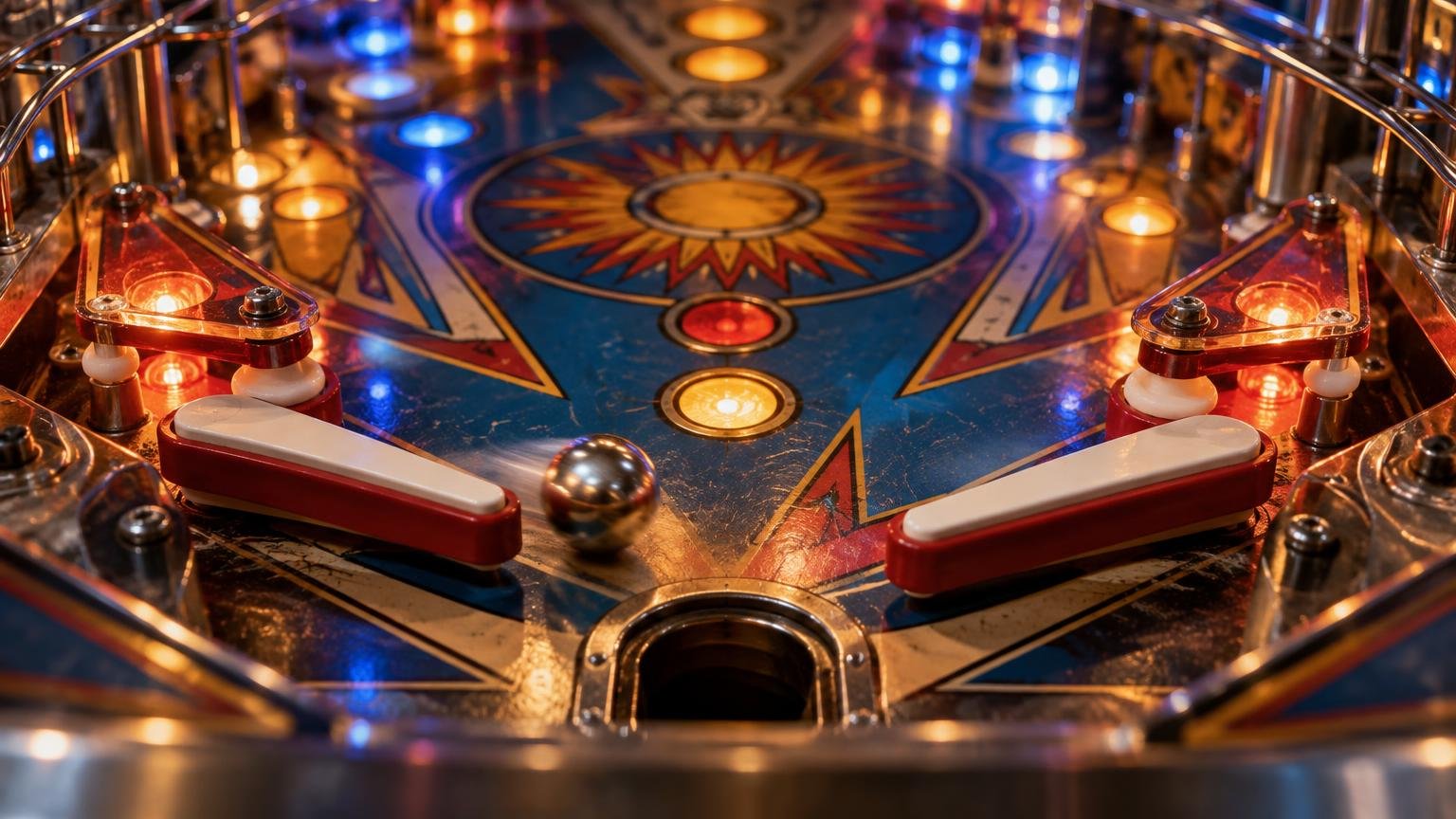
What Is a Dead Bounce in Pinball and When Should You Use It?
If you are asking what is a dead bounce in pinball and when should you use it, the short answer is this: a dead bounce is an intentional no-flip transfer. You leave the flippers down, allow the incoming ball to strike a resting flipper, and use the rebound to send it toward the opposite side. The goal is not an immediate shot. It is to turn a predictable feed into a calmer, more useful next decision. The technique is also commonly called a dead flip.
Use a dead bounce when the ball is approaching with enough pace and at an angle that should carry it safely across the playfield. Avoid it when the ball is slow, sharply diagonal, unpredictable, or likely to catch the junction between the flipper and its guide. A good dead bounce can look effortless; a bad read can produce the most irritating kind of center drain because you deliberately chose not to flip.
How a dead bounce works
The basic sequence is simple, although reading the feed takes practice:
- Watch the incoming ball and judge its speed and approach angle.
- Keep both flippers down rather than reacting with an automatic flip.
- Let the ball strike the resting flipper and rebound toward the opposite side.
- Track the transfer and decide whether to cradle, catch or shoot with the receiving flipper.
The important action is restraint. Many newer players press a flipper button whenever a ball enters the lower playfield, even if that flip sends the ball back into danger. A dead bounce replaces that reflex with a deliberate read: do nothing now so that the next touch can be better.
The move is easier to understand visually, and the MAYA Pinball animated guide to flipper skills illustrates the lowered-flipper rebound and cross-field transfer. Its instructional guidance emphasizes leaving both flippers down during the initial contact.
A dead bounce does not guarantee a cradle on the other flipper. Depending on the feed and the machine, the ball might reach the opposite flipper at a comfortable catching speed, roll toward its base, or require another quick control decision. Think of the technique as a transfer that creates an opportunity, not as an automatic stop.
When should you use a dead bounce?
When the feed is predictable
Predictability matters more than bravado. The best candidate is a repeatable ball return that arrives at a familiar angle with enough energy to rebound across the gap. If you have seen the same feed several times and know where its rebound goes, leaving the flipper down can be more controlled than improvising a shot.
Instructional descriptions of the technique consistently emphasize both path and pace. The ball needs a suitable approach and enough momentum to reach the other side; a slow or awkward arrival can fall away from the flipper and head toward the center instead.
When the opposite flipper offers the better next play
Sometimes the ball arrives on the wrong side for the shot you want. A dead bounce can move it to the flipper with the cleaner ramp, orbit or target-bank angle. That is especially useful when flipping immediately would make a low-percentage shot or send the ball toward a dangerous rebound.
This is the strategic value of the move: it can improve the next decision without adding an unnecessary powered flip. The value depends on the table layout and current rules objective. If the receiving side does not offer a better option, transferring the ball merely because you can may add risk without adding much benefit.
When an immediate flip would be a panic reaction
A powered flip is not automatically safer than leaving the flipper down. An early or poorly timed flip can accelerate the ball, reject it toward the center, or turn a manageable feed into uncontrolled play. When a passive rebound has been reliable, the dead bounce is often the calmer choice.
When a dead bounce is the wrong choice
Skip the move when you cannot reasonably predict the transfer. Warning signs include a ball that is losing speed, bouncing laterally through the lower playfield, approaching at a severe angle, or heading for the small junction where the flipper meets the adjacent guide. Contact around that junction can kill the expected rebound or redirect the ball toward the drain.
I would also avoid forcing a dead bounce when the ball is already arriving on the side needed for the next valuable shot. Passive control is useful, but it is not a style point. If a controlled flip, catch or cradle produces the better outcome, use it.
- Use it: the feed is familiar, adequately paced and directed toward the face of a resting flipper.
- Think twice: the transfer sometimes reaches the other side but sometimes falls toward the center.
- Avoid it: the ball is slow, chaotic, sharply diagonal or headed toward the flipper-guide junction.
- Choose another technique: the current flipper already gives you the shot or control position you want.
Dead bounce versus other flipper-control techniques
A dead bounce belongs in a collection of control skills. It is not inherently more advanced or better than an active catch. The right choice is whichever technique best matches the incoming ball and the next shot.
| Technique | What the player does | Best general use |
|---|---|---|
| Dead bounce or dead flip | Leaves the flippers down and allows a passive rebound toward the other side | Transferring a predictable, adequately paced feed |
| Live catch | Raises a flipper to meet the ball and absorb its arrival near the top of the stroke | Stopping a suitable incoming ball on the same side |
| Drop catch | Lowers a raised flipper as the ball makes contact to remove energy | Controlling an arrival that can be matched with precise timing |
| Cradle | Holds a raised flipper so the ball rests against the inlane area | Pausing to plan a controlled shot |
| Immediate flip | Strikes the ball without first settling it | Making a needed shot or defending against a feed that should not be allowed to bounce |
The dead bounce requires the least button input during initial contact, but that does not make it the least demanding. Its skill lies in recognizing the feed before the ball reaches the flipper. A live catch or drop catch relies more heavily on timing. A cradle is the resulting controlled position rather than the transfer used to reach it.
Why dead-bounce attempts drain down the middle
The usual failure is a mismatch between the expected and actual rebound. The player expects the ball to cross the center, but it leaves the resting flipper with too little sideways momentum. It then falls into the gap instead of reaching the opposite flipper.
That can happen because the incoming ball was too slow, the approach was too diagonal, or contact occurred too close to the flipper-guide junction. It can also happen because the player learned the move on another machine and assumed the same visual feed would produce the same result here.
The individual machine changes the result
Dead bounces are machine-specific. Rubber condition, ball condition, flipper alignment, playfield geometry and setup can all affect how energy is returned or absorbed. Even two examples of the same title should not be assumed to behave identically after years of use and adjustment.
Manufacturer service guidance shows why condition matters. Stern Technical Service Bulletin No. 119 instructs operators to inspect flipper components and replace worn or dirty rubber and worn balls. It also provides a playfield-pitch recommendation for the particular setup addressed by that bulletin, not a universal dead-bounce setting.
For an owner, an abruptly changing dead bounce can therefore be a useful observation. It does not diagnose a fault by itself, but it is a reason to inspect whether the ball is unusually worn or dirty, whether the rubber has changed, and whether the flipper is returning fully to its resting position. Do not adjust an otherwise functional machine merely to manufacture a stronger bounce; the priority is consistent, safe operation across the whole game.
Dead bounces in virtual pinball
The same decision-making lesson carries into virtual pinball: read the feed, resist an unnecessary flip and see whether the resting-flipper rebound creates control. The exact result, however, depends on the table implementation, physics settings, platform and input behavior.
A VPForums discussion provides one limited example in which a lowered-flipper rebound on a VPX table behaved differently from the corresponding physical machine. That community observation should not be treated as a finding about every VPX table, but it illustrates why the technique needs to be tested table by table rather than assumed to match a physical game.
Virtual practice can still help with visual recognition and the discipline of not flipping. Just avoid treating success on one recreation or platform as proof that the same feed will transfer on a physical cabinet.
A dead bounce is not a death save or bangback
Despite the similar words, a dead bounce is unrelated to a death save. A dead bounce is ordinary flipper control performed before the ball drains: the player leaves a flipper down and uses its rebound. Death saves and bangbacks are aggressive cabinet maneuvers intended to return a ball after it has entered an outlane or drain area.
Published PAPA/IFPA competition rules distinguish prohibited death saves and bangbacks from ordinary flipper-control play. A normal dead bounce should not be confused with either maneuver, although players should always follow the rules and rulings of the specific event they enter.
A simple drill for learning the dead bounce
Choose one physical machine and concentrate on a repeatable return that reaches a flipper without first becoming chaotic. Do not try to dead-bounce every incoming ball. The purpose of the drill is to identify one reliable feed and learn its limits.
- During five consecutive balls, identify the feed before it reaches the lower playfield.
- On the first suitable example, watch the path without committing to the move unless it looks safe.
- When the same feed returns with adequate pace, leave both flippers down and observe where the rebound travels.
- Note whether the ball reaches the opposite flipper, falls toward the center or catches the guide junction.
- On later attempts, decide before contact whether to dead bounce, catch or flip. Judge the quality of the decision, not just whether the ball happened to survive.
The practical rule is straightforward: use a dead bounce on a predictable feed with enough pace to cross safely, especially when the opposite flipper gives you a better next play. Skip it when the ball is slow, diagonal, chaotic or joint-drain-prone. Start by learning one dependable transfer on one machine; once that read becomes familiar, add the technique to your game rather than trying to make your whole game revolve around it.
Frequently Asked Questions
What is a dead bounce in pinball?
A dead bounce is a passive transfer in which you leave the flippers down and let the ball rebound from one resting flipper toward the other.
Is a dead bounce the same as a dead flip?
Yes. The terms “dead bounce” and “dead flip” are commonly used interchangeably for this technique.
Do you leave both flippers down during a dead bounce?
Yes. Both flippers remain down during the initial contact, after which you decide whether to catch, cradle or shoot the transferred ball.
When should you use a dead bounce?
Use it when the feed has a predictable path and enough pace to cross safely, particularly when the opposite flipper offers a better next play.
Why can a dead bounce drain down the middle?
A slow or awkwardly angled ball may leave the resting flipper without enough sideways momentum to cross the gap. Contact near the flipper-guide junction can also disrupt the expected rebound.
Can you nudge during a dead bounce?
A small, well-timed nudge can sometimes help the transfer, but it adds another control variable and can contribute to tilt risk. Learn the unassisted rebound first.
Do dead bounces work the same way on every machine?
No. The result can vary by feed, machine setup and condition. Rubber, balls and flipper components should be kept clean and in suitable condition.
Is a dead bounce the same as a death save or bangback?
No. A dead bounce is ordinary flipper control before the ball drains. Death saves and bangbacks are aggressive ball-saving maneuvers treated separately by the supplied PAPA/IFPA competition rules; always follow the rules of the specific event.