How to Buy Your First Pinball Machine: New vs Used, Budget, Space, and Maintenance
TLDR: The best way to learn how to buy your first pinball machine is to apply four filters before falling for a title: total ownership cost, the physical route into your room, condition and support, and repeat-play appeal. New is usually the simpler ownership path; used can stretch your budget further if you can inspect the game properly. Avoid making a project machine your first and only game unless repairing it is part of the fun you want.
A famous theme and a great first game are not necessarily the same thing. When deciding how to buy your first pinball machine, look beyond the advertised price and imagine the entire first year: delivery, stairs, setup, minor adjustments, replacement rubbers or balls, software updates, and the occasional switch that decides it no longer wants to cooperate on a Saturday night.
I would not start by making a list of the hobby’s most popular titles. I would first establish what can enter the home, what level of maintenance feels reasonable, and what the full purchase can cost without creating immediate regret. A machine that passes those tests earns a place on the shortlist.
Use four filters to buy your first pinball machine
| Filter | What to verify | Reason it matters |
|---|---|---|
| All-in cost | Machine, tax, transport, access work, setup, and initial service allowance | The sticker price is only one part of the purchase |
| Access path | Exact machine or carton dimensions, weight, doors, turns, stairs, and final position | A game can fit in the room but fail to reach it |
| Condition and support | Inspection results, manual, parts information, code resources, warranty, and local help | This determines how manageable ownership will be |
| Repeat-play fit | Shot flow, rules, difficulty, theme, and meaningful trim differences | The goal is a game you still want to play after the novelty fades |
New vs used: choose the ownership experience, not the prestige
A new machine generally offers more predictable cosmetic condition, current documentation, and a clearer route to manufacturer or dealer support. For example, Stern states that its limited warranty lasts one year for the original end-user purchaser when a machine is bought directly from Stern or through an authorized reseller. Its terms also contain exclusions, including consumable items such as pinballs and rubbers, certain cosmetic or shipping damage, and unauthorized modifications. Read the current warranty for the exact purchase rather than assuming every issue is covered.
New does not mean maintenance-free. Pinball is a physical game full of moving balls, switches, coils, lamps, rubber rings, fasteners, and adjustable assemblies. Even a new game may eventually need cleaning, leveling, a switch adjustment, or a consumable replaced. What new can provide is a less ambiguous starting point.
Used machines offer a wider range of eras, themes, prices, and configurations. A well-maintained used game can be a sensible first purchase because another owner may already have handled early adjustments. The tradeoff is that condition varies substantially. Two examples of the same title can differ in cabinet wear, playfield condition, modifications, repair quality, software version, and maintenance history.
For most first-time buyers, the useful dividing line is not simply new versus used. It is ready-to-play versus project. If you mainly want to play pinball, buy a machine that boots reliably, completes full games, passes its major diagnostic tests, and has no known repair preventing normal operation. Buy a project only if troubleshooting and restoration are intentional parts of the purchase—and preferably not as the only playable game in the room.
Build an all-in budget before comparing titles
Set two numbers: a machine-price ceiling and a separate ownership buffer. The second amount should account for taxes where applicable, delivery or vehicle rental, difficult access, setup help, basic consumables, and initial service. There is no responsible universal delivery allowance because distance, stairs, parking, insurance, crew size, and inside placement can change the quote.
When comparing new machines, match the exact title and trim. Pro, Premium, Limited Edition, and similarly named versions may differ in mechanisms, artwork, accessories, and price. Manufacturer pricing also varies by game and configuration, so record the model, edition, date, seller terms, and what delivery includes. Do not compare the delivered price of one machine with the pre-tax pickup price of another.
The buffer should remain available after the machine arrives. Spending every dollar on the cabinet can turn a minor service need into a source of frustration. A slightly less expensive game with money left for safe transport and proper setup is often the stronger first-machine decision.
Measure the entire route, not just the game room
Pinball machines are heavy, awkward loads whose backboxes, legs, and packed dimensions vary. One current Stern product-page example lists an approximate assembled weight of 270 pounds, a packed weight of 285 pounds, and a 56-by-31-by-31-inch carton. Those figures illustrate the scale involved; they are not universal specifications for every game. Obtain measurements and moving instructions for the exact machine you plan to buy.
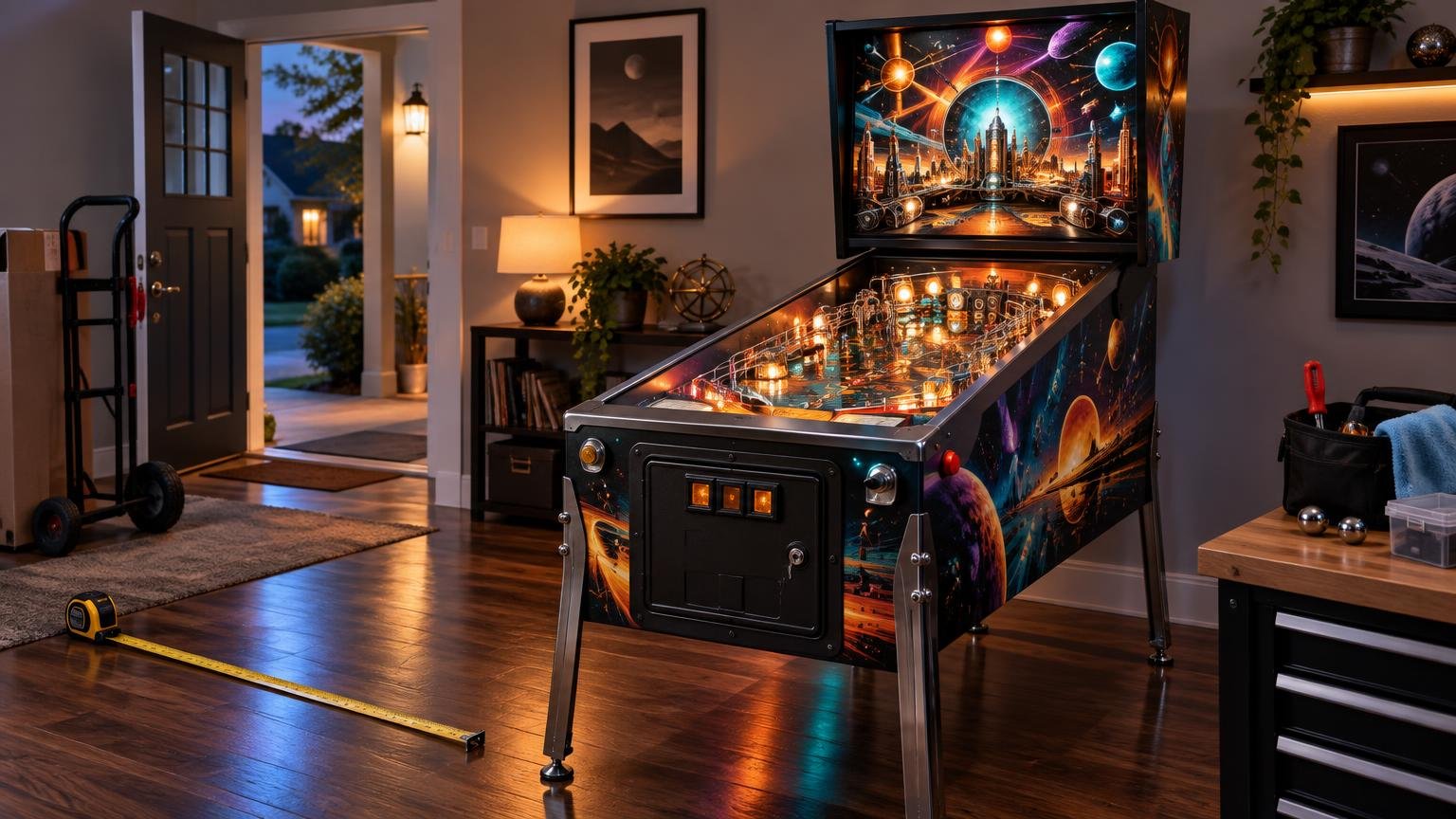
Trace the route from the seller or delivery vehicle to the final position. Measure the narrowest door opening rather than the door slab, and account for handles, hinges, railings, low ceilings, thresholds, tight turns, and stair landings. Check whether the backbox folds and whether any toppers or accessories must be removed. Protect both the machine and the floor.
- Confirm the machine’s assembled and transport dimensions with the seller or manual.
- Measure every doorway, hallway turn, stair landing, threshold, and elevator opening.
- Decide who will remove and reinstall the legs, backbox hardware, topper, or other accessories.
- Specify whether delivery means curbside drop-off, entry into the home, or placement and setup in the final room.
- Agree in writing on who carries the risk of damage during loading, transport, stairs, and assembly.
- Verify the final location’s power requirements against the manual for that exact model and region.
If stairs or a tight turn are involved, send the mover photographs and measurements before accepting a quote. A seller saying that a game “should fit” is not a moving plan. Also consider future removal: the route must work again if the machine needs service or is eventually sold.
Choose a game for the hundredth play, not the first five
Theme matters because music, callouts, artwork, and presentation are part of every game. But theme alone cannot tell you whether you will enjoy the shots or rules. Play the candidate in person when possible, ideally across several sessions rather than one unusually good or bad game.
Pay attention to how clearly the machine communicates its objectives, whether the major shots feel satisfying, and how often a missed shot leads to an immediate drain. A difficult game can be rewarding, but a household of newer players may get more use from a machine with understandable early goals and forgiving progress. Conversely, an experienced player may prioritize deeper modes, risk-and-reward decisions, or long-term scoring strategy.
Compare trims by features you can feel during play. Ask which mechanisms, shots, modes, artwork, or accessories differ and whether those changes improve the parts of the game you value. A higher trim is not automatically the better first purchase if its added features do not improve your preferred style of play.
If local play is impossible, watch full, minimally edited gameplay rather than only trailers. Read the rules overview, note how progress is saved or reset, and look for model-specific owner discussions. Enthusiast opinion is useful for identifying recurring complaints or beloved features, but taste remains personal. The most revealing question is simple: after a poor game, do you immediately want another attempt?
Make support and maintenance part of the shortlist
Before paying, find the manual for the exact title and edition. Check whether it includes setup instructions, diagnostics, switch information, parts diagrams, and schematics. Stern says its manuals contain setup and settings information plus game-specific parts and schematics, and its support resources include setup guidance, service material, and technical-support channels.
Documentation is valuable, but a parts diagram does not prove that every component is currently stocked. Search for title-specific replacement parts and ask who supports the machine in your region. If a distinctive mechanism fails, determine whether the part is available, repairable, or dependent on used inventory. Also check whether the manufacturer still provides relevant game-code files and release notes.
Basic ownership should feel manageable even if you do not want restoration as a second hobby. A sensible starter kit can include the correct cabinet and backbox keys, clean balls and game-specific rubbers when needed, suitable cleaning supplies, spare fuses of the specified type, and the manual. Do not replace a specified fuse with a different rating or work around exposed high-voltage areas without the appropriate knowledge.
Inspect a used machine before money changes hands
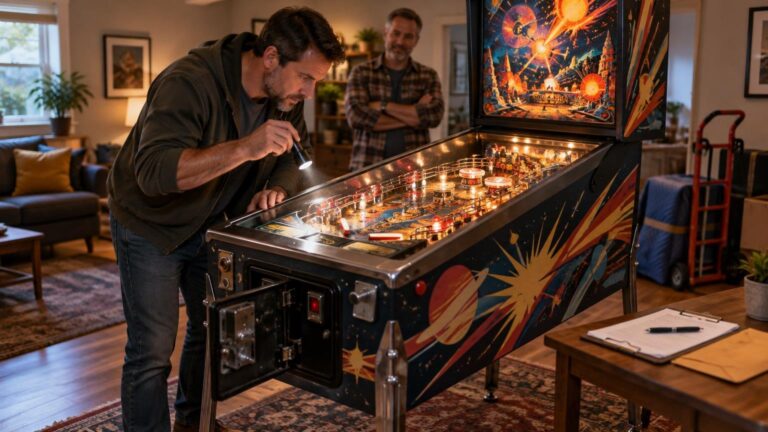
An in-person inspection should include more than a quick game. Start with the machine cold if possible so you can observe its boot process. Play every major shot and mechanism, then open the service menu with the owner and run available switch, lamp, display, sound, and coil tests. Listen for mechanisms that struggle, repeat unexpectedly, or fail intermittently.
- Inspect the cabinet, backglass or translite, display, playfield, ramps, plastics, posts, and toys under bright light.
- Look for broken plastics, worn areas, damaged inserts, lifting artwork, corrosion, improvised wiring, and burnt connectors.
- Confirm that flippers, pop bumpers, slingshots, switches, locks, ramps, magnets, motors, and multiball devices operate as intended.
- Check the serial number and record the exact title, trim, included accessories, keys, manual, and removable upgrades.
- Ask for maintenance and repair records, known faults, modification details, and the installed software version.
- Write down the price, deposit terms, payment method, pickup date, included items, and what happens if the machine differs materially from its description.
For a remote purchase, request a continuous video showing the machine’s exterior, cold boot, service menu, diagnostics, and complete gameplay. Ask for close photographs of known wear areas, boards, connectors, the underside of the playfield, and any modifications. Independently verify the seller and arrange payment and transport on terms you understand. If the seller will not demonstrate that an expensive machine exists and functions as described, walk away.
Treat resale value as a flexibility benefit, not a promised return
Resale matters because the first machine often teaches an owner what they actually enjoy. Research comparable examples by exact title, trim, condition, modifications, and region. The Pinside Marketplace can help locate active ads, while its archive provides historical listing context. Those figures are asking prices, however, not proof of completed sale prices or future value.
Record how long comparable ads appear to remain available and note meaningful condition differences. A rare topper, premium upgrade, or desirable modification may matter to one buyer and be irrelevant to another. Moving costs also affect the real result: selling for roughly what you paid does not recover taxes, delivery, repairs, or the work of moving the game again.
First pinball machine buying checklist
- Set a maximum machine price and keep a separate delivery and initial-service buffer.
- Decide whether you want the simpler path of new, a ready-to-play used game, or an intentional project.
- Measure the complete access route and obtain exact dimensions for the candidate machine.
- Play the title repeatedly or study full gameplay, rules, difficulty, and trim differences.
- Find the exact manual, support channels, software resources, and title-specific parts information.
- Inspect the machine and run diagnostics, or request clear remote proof of condition and operation.
- Document the exact machine, included items, known faults, payment terms, transport responsibility, and pickup or delivery plan.
- Compare resale listings cautiously without treating asking prices as completed sales.
- Keep enough budget and patience for routine care after the game arrives.
Make the practical fit your final decision
The best first machine is not automatically the newest cabinet, the highest trim, or the title with the loudest reputation. It is the game that fits through the door, stays inside the real budget, has a support path you can live with, and makes you want to press Start again.
Before placing a deposit, complete one final four-part check: all-in cost, access route, condition and support, and repeat-play fit. If the machine fails any one of those tests, keep looking. Pinball should add a satisfying challenge to the game room—not turn delivery day into the hardest mode on the machine.
References
- Limited Warranty – Stern Pinball
- Pokémon By Stern Pinball
- Stern Pinball: World's Largest Manufacturer of Arcade-Quality Pinball Games
- How to Set Up – Stern Pinball
- STERN OF THE UNION ADDRESS – JUNE 2026 – Stern Pinball
- Pinside Marketplace » New and used pinball games, parts and mods | Pinside Market
- Pinside Marketplace » Ads archive | Pinside Market