How to Buy a Pinball Machine From a Private Seller
TLDR: Buy the exact machine, not the description in its listing. Verify the seller and serial number, request current photos and video, inspect and play the game, put the complete agreement in writing, and plan transportation before sending money. For a first private purchase, a local machine you can inspect and collect is usually easier to evaluate than a remote deal involving freight.
Learning how to buy a pinball machine from a private seller is mostly about controlling uncertainty. A private sale can put an excellent game in your home, but the buyer usually has to verify condition, understand what is included, arrange payment and solve the move. Marketplace feedback and labels such as “home use only” can inform that work; neither replaces it.
This guide concerns physical pinball machines. A virtual cabinet requires a different inspection of its computer, displays, controls, software and licenses. If you are still deciding between new and used—or whether ownership fits your budget and space—start with the broader first pinball machine buying guide.
How to buy a pinball machine from a private seller safely
The strongest private transaction has six clear elements: a credible seller, an identifiable machine, current evidence of condition, an in-person inspection when practical, a written agreement and a realistic collection plan. If one of those remains vague, pause rather than allowing enthusiasm for a scarce title to set the schedule.
I would favor a local transaction for a first purchase. It lets you see the actual game running, compare the listing with its condition and complete payment at the agreed handoff. A remote purchase is not automatically bad, but it adds packing, freight, insurance and payment risk before you have stood in front of the machine.
Screen the listing before arranging a visit
Begin by confirming the exact title and edition. Modern games can have several editions with different artwork, mechanisms and included features. Older titles may have similarly named versions or conversions. The searchable Internet Pinball Machine Database can help confirm a commercially produced game’s manufacturer and era, but IPDB explicitly does not sell machines or track their value. Use it for identity and historical reference, not as an appraisal.
Ask the seller for current, well-lit photos rather than relying entirely on images already attached to the listing. The useful set includes the whole cabinet, both cabinet sides, front, backbox, playfield with the glass removed if the seller can do so safely, display, coin door and interior areas that can be photographed without risky disassembly. Request close-ups of wear, broken plastics, damaged artwork, rust, swelling or previous repairs.
Also request a current video showing the machine starting and playing. It should demonstrate that the video depicts this game rather than another example of the same title. A simple agreed detail—such as showing a handwritten date beside the cabinet—can make the evidence more useful. Video cannot prove every switch or device works, but it can reveal whether the machine exists in the represented location and broadly operates.
- What is the complete title and edition?
- What serial number appears on the machine, and where is its label located?
- How long has the seller had it, and why is it being sold?
- Which faults, intermittent problems or cosmetic defects are known?
- What repairs, replacements and modifications have been made?
- Are the keys, manuals, toppers, spare parts and removed original parts included?
- Can the machine be inspected and played before payment?
- Is pickup required, or has the seller agreed to prepare it for freight?
Check the seller’s history where the marketplace provides it. Pinside, for example, incorporates member feedback into its sales system, but it also states that payments are private matters between buyer and seller and that it cannot mediate or reverse a transaction. Treat positive feedback as one reputation signal, not buyer protection.
Inspect the machine rather than trusting condition labels
Terms such as “HUO,” “mint,” “collector condition,” “restored” and “fully shopped” are not standardized grades. Ask what each label means for this seller and this game. “Shopped” could describe anything from cleaning and new rubbers to extensive mechanical work. A useful answer names the work, parts, date and person who performed it.
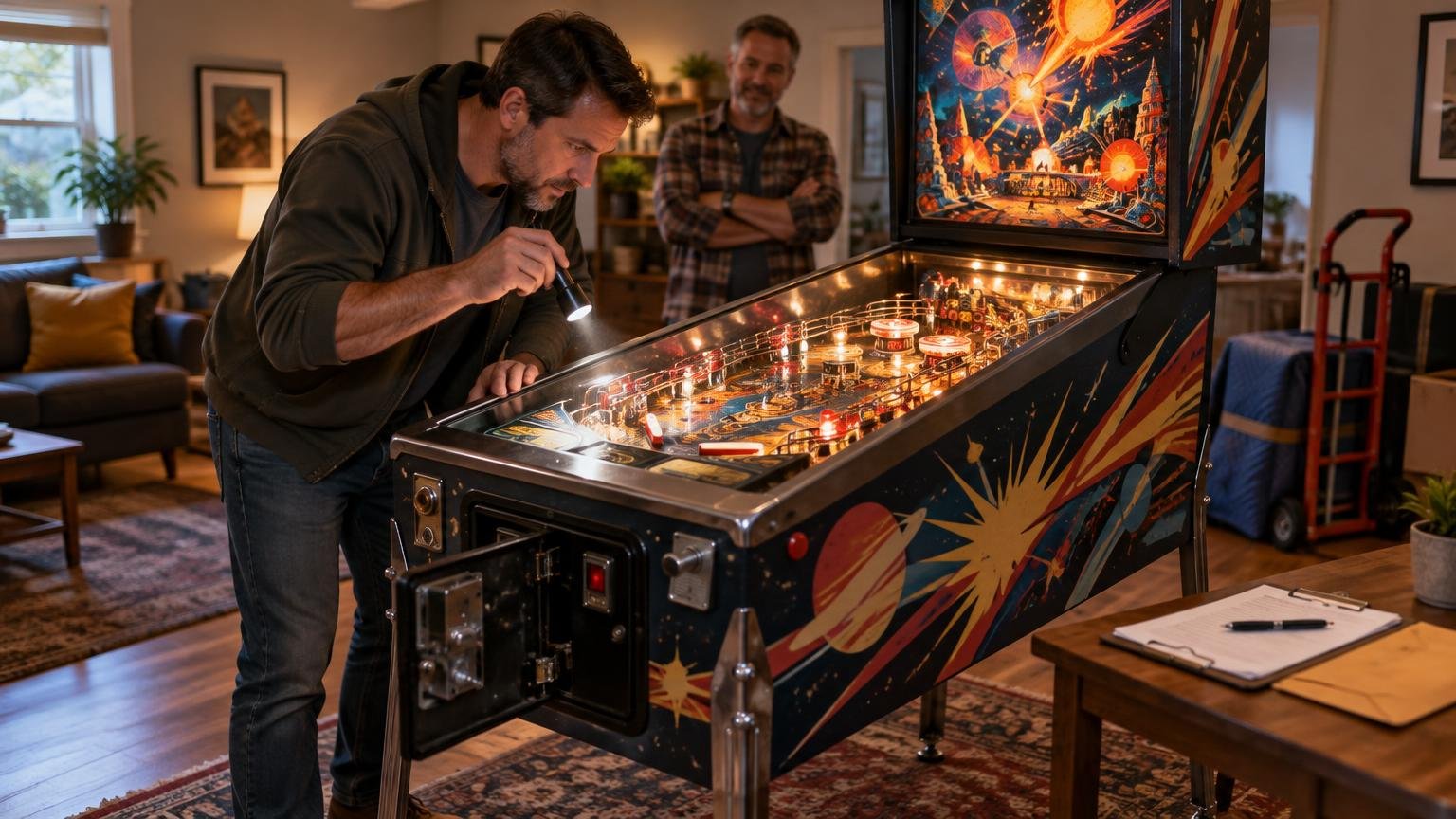
Inspect the cabinet and backbox before turning your attention to gameplay. Look for swelling, separation, stains or odors that might indicate moisture exposure. Check the legs, bolts, hinges, glass channels, lockdown bar and coin door for damage or missing hardware. Cosmetic cabinet wear may be acceptable at the right price; structural damage deserves closer investigation because it affects ownership and transport, not just appearance.
On the playfield, examine high-traffic areas around inserts, ball paths, kickers and scoops. Look for worn artwork, lifted inserts, cracked ramps, broken plastics, improvised repairs and missing hardware. Dust is not the same as damage, and a spotless game is not necessarily mechanically sound. Your goal is to distinguish routine cleaning and adjustment from faults that require parts, technical work or hard-to-source artwork.
Where access is safe and the seller agrees, inspect inside the cabinet and backbox for loose wiring, corrosion, moisture evidence, burned connectors or undocumented modifications. Older electronic machines deserve particular attention around any battery area. Do not reach into a powered cabinet or remove assemblies beyond your competence merely to complete a checklist.
Play enough to find patterns
One short ball is not a meaningful inspection. Play several games and use the features that matter on that title: both flippers, slingshots, pop bumpers, targets, ramps, locks, troughs, multiball devices, displays and sound. Watch for weak or inconsistent mechanisms, balls that fail to return, repeated switch behavior, unexpected resets and error messages.
Ask the seller to open the machine’s built-in diagnostics if the game provides them and both of you know how to use them. Tests can help exercise lamps, switches, coils, displays and sound, but menus differ across manufacturers and eras. An apparently clean test does not replace normal play, because some faults appear only after repeated use or vibration.
Write down every issue you find and ask whether it was already known. A machine does not need to be perfect to be worth buying. It does need a condition and price you understand. If you cannot estimate a repair confidently, obtain advice or price the uncertainty as a real cost rather than assuming it will be a five-minute adjustment.
Evaluate price as part of total ownership cost
There is no universal private-sale discount or formula that makes a price fair. Compare the same title and edition in broadly similar condition, then account for included accessories, documented work, missing parts and your collection costs. Asking prices show seller expectations, not necessarily completed-sale values.
Think beyond the number in the listing. Your initial ownership cost can include travel, vehicle rental, freight, insurance, stairs or specialist moving help, replacement locks, immediate service and missing parts. A nearby machine at a slightly higher price may be the better purchase if you can inspect it and avoid complicated freight.
Do not let upgrades automatically justify their original retail cost. A modification is valuable only if you want it, it is installed competently and it does not create a maintenance problem. Ask whether removed factory parts come with the game; having them preserves options for later repairs or a return to the original configuration.
Put the complete agreement in writing
A written record prevents a friendly conversation from turning into two different memories. Local requirements for contracts, tax and bills of sale vary, so check the rules where the transaction occurs. At minimum, the document or retained message thread should identify what is changing hands and under what conditions.
- Buyer and seller names and contact details
- Machine title, edition and serial number
- Agreed price and any deposit already paid
- Included keys, manuals, accessories, modifications, spares and original parts
- Known faults and agreed condition wording
- Inspection, payment and possession dates
- Who loads, packs, transports and unloads the machine
- Who arranges freight or insurance and bears transit-damage risk
- What happens if the machine differs materially from the agreement before handoff
- Signatures or written acceptance by both parties
Do not assume a remaining manufacturer warranty transfers with a used game. Warranty terms depend on the manufacturer, model, original purchase and written policy. If warranty coverage affects the price you will pay, verify it directly under the applicable terms before agreeing to the sale.
Match payment to the transaction risk
For a local sale, the cleanest sequence is normally to inspect the machine first, finalize the written terms and complete payment at the agreed handoff. If a deposit is requested, document its amount, purpose, refund conditions and deadline. There is no universal deposit percentage or payment app that makes every transaction safe.
Remote deals demand more caution because the buyer may have to pay before collection or shipping. The FTC’s guidance for buying through online marketplaces recommends understanding refund and return terms, reviewing photos of the actual item, retaining written communications and avoiding payment methods that make recovery difficult when something goes wrong. A seller insisting on urgent, irreversible payment while resisting verification is giving you a reason to leave.
Keep copies of the listing, photos, video, messages, payment records and signed agreement. Confirm payment instructions through a previously established contact method if they suddenly change. Marketplace accounts and email conversations are useful, but neither proves that the person requesting funds controls the machine.
Plan the move before committing
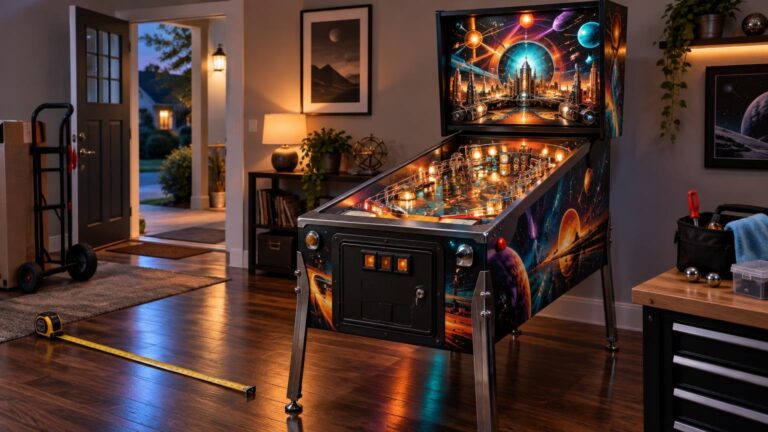
A pinball machine is not just heavy furniture; it has glass, moving assemblies, a backbox and model-specific securing points. Before buying, confirm the machine’s measurements, every doorway and turn on the route, the vehicle’s usable opening, the number of capable helpers, required tools, protective blankets and appropriate restraints. Plan the destination as carefully as the pickup.
Use the manual for the exact model whenever one is available. For example, Stern’s Star Wars Home Edition Plus documentation instructs owners to transport that hinged-backbox model with its backbox down and identifies serial-number locations specific to it. Those details support handling that machine, not every pinball machine ever produced. Copying a folding or securing procedure from another title can damage hardware or wiring.
Photograph the machine immediately before loading, including its condition and any separately packed parts. Inventory the keys, balls, bolts, topper, manuals and spares. Clarify who is physically responsible for packing and loading; “pickup included” and “seller will help load” are not the same promise.
Private-sale red flags that justify walking away
- The seller will not provide new photos or a current operating video.
- The serial number, edition or physical machine does not match the listing.
- Inspection is refused even though the machine is supposedly available locally.
- Condition questions receive only labels such as “mint” or “shopped,” with no specifics.
- The seller changes the payment destination or demands an irreversible method urgently.
- A third-party shipper or relative appears late in the conversation and cannot be verified.
- The seller discourages written terms or will not list included accessories and parts.
- The machine cannot be demonstrated, yet its price assumes fully working condition.
- The collection plan depends on improvising the vehicle, helpers or securing method after payment.
A red flag is not proof of fraud, but you do not need to prove fraud to decline a risky purchase. Private sellers can have legitimate scheduling constraints or limited technical knowledge. The practical test is whether their answers and evidence reduce uncertainty enough for the money involved.
The final go-or-no-go checklist
Proceed only when you can answer yes to the essentials: you have verified the seller as far as practical; identified the exact title, edition and serial number; seen current evidence; inspected and played the game or knowingly accepted the added risk of not doing so; documented its condition and included parts; agreed on payment and possession; and prepared a model-appropriate moving plan.
The best technique for how to buy a pinball machine from a private seller is deliberately unglamorous: slow the transaction down until the machine, money and move all make sense. If the seller will not demonstrate the actual game, answer reasonable condition questions or document the handoff, walk away. Another machine will be more fun than turning an avoidable mystery into your first repair project.