How Modern Pinball Machines Are Designed and Manufactured
TLDR: The short answer to how modern pinball machines are designed and manufactured is that gameplay, mechanisms, electronics, software and presentation are developed together through repeated iteration. Once the design is ready for production, workers integrate the cabinet, playfield, wiring, mechanisms, boards, display and artwork. Software then interprets every switch hit and controls the rules, scoring, lights, sound and coils—and it may continue receiving updates after the physical machine ships.
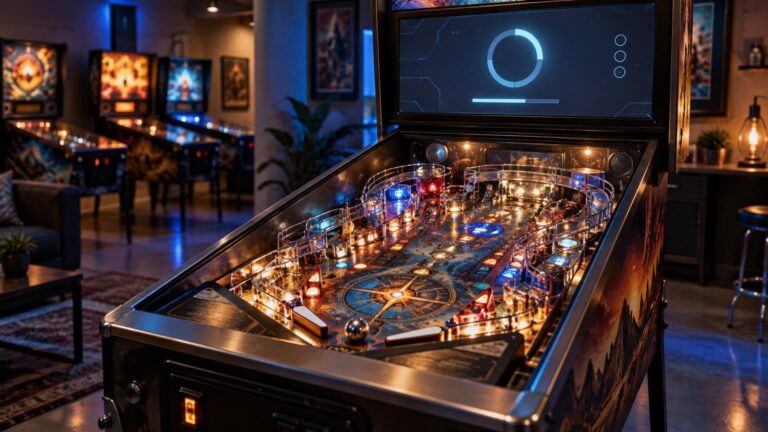
A modern physical pinball machine is part arcade game, part appliance and part electromechanical theater. Its ramps and toys get the attention, but the real design challenge is making shots, rules and audiovisual feedback work as one coherent game while also meeting practical limits involving cost, durability, service access, scheduling and production. For a buyer, that explains why a visually spectacular machine is not automatically the most enjoyable or easiest one to own.
How modern pinball machines are designed and manufactured
There is no single universal workflow followed by every manufacturer. Team structures, production methods and development schedules vary. The useful general model is a cycle: establish the concept, develop the playfield and rules, engineer the mechanisms and electronics, test and revise the whole game, prepare it for production, assemble the machines and continue supporting them in the field.
That cycle is not a tidy relay race in which the mechanical designer finishes before software development begins. Moving a ramp can change shot difficulty. Changing a shot can alter mode objectives. A new mechanism may require different sensors, coil behavior, lighting cues, sound effects and service access. Each decision can travel through several parts of the game.
The concept has to survive practical constraints
A project generally begins with a theme or gameplay direction. For a licensed title, the team must also work within the material and approvals available from the rights holder. Designers then have to turn that broad concept into a physical game that can be manufactured, transported, installed, played repeatedly and repaired.
This is where commercial pinball differs from a one-off home project. The design cannot be judged only by whether a prototype is fun. Its mechanisms must be suitable for repeated production, parts need to fit consistently, assemblies need to be reachable for service, and the complete product has to stay within its cost and schedule constraints. Those pressures influence everything from the number of custom toys to the shape of a ramp.
Several disciplines contribute: game and playfield design, mechanical and electrical engineering, software, rules, artwork, animation, lighting, sound, production engineering and licensing. The exact job titles and division of responsibility vary, but no single discipline can carry a sophisticated modern game by itself.
Playfield layout and game rules develop together
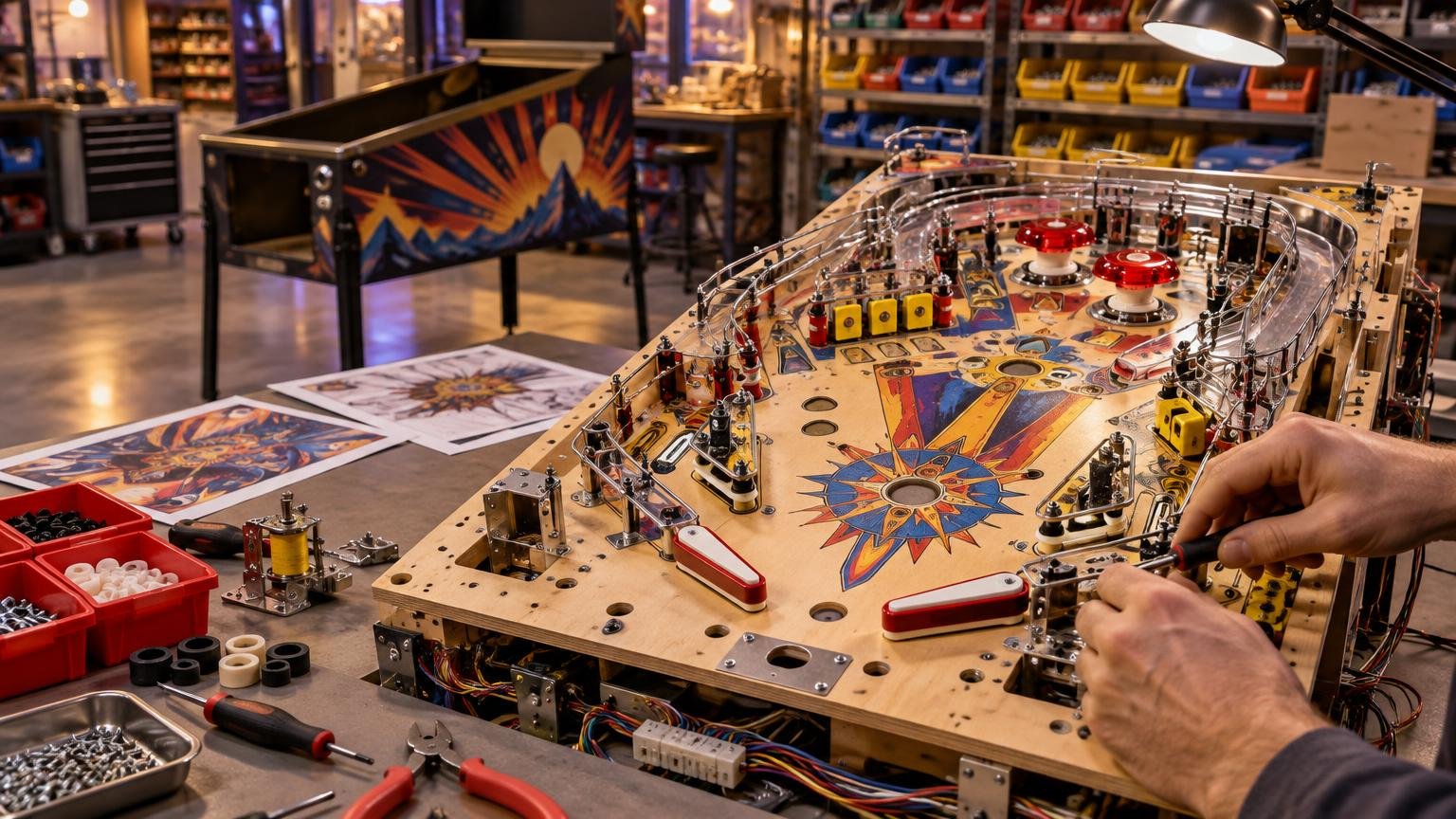
The playfield begins as a proposed arrangement of flippers, shots, lanes, targets, ramps and mechanisms. Digital layout tools help establish geometry, but physical prototypes reveal what a drawing cannot: how the ball approaches a shot, whether a return is controllable, where air balls occur and whether a ball can become trapped.
Popular Mechanics’ report on Stern’s design and factory process documented the use of digital layout work, physical mockups and repeated adjustment to refine shot flow and mechanism behavior. That is a useful example of commercial development, although it should not be treated as a fixed formula used by every company or every current title.
Iteration may involve shifting a post, changing a ramp entrance, adjusting a guide or revising the strength and timing of a mechanism. Tiny physical changes can make the difference between a smooth repeatable shot and one that rejects the ball unpredictably. Designers also have to consider how the layout plays for people with different skill levels: experts need strategy and scoring depth, while newer players need understandable objectives and enough ball time to discover the game.
Rules are built around those physical opportunities. A switch closure might advance a mode, score a jackpot, change the music and launch an animation. George Gomez has described the player’s feedback as a combination of physical changes, display events, lighting, sound, scoring and progression goals. In a successful design, those channels reinforce the same event instead of competing for attention.
The machine is a network of mechanical and electronic systems
Under the artwork, a modern game contains layers of equipment that must cooperate. The cabinet and backbox provide the structure. The playfield carries the ball guides, posts, targets, switches, lamps and mechanisms. Coils create rapid physical movement for devices such as flippers, pop bumpers and kickers, while motors can drive slower or more elaborate mechanisms.
Electronic boards distribute power, read switch states, control lamps and LEDs, drive coils or motors, process the rules and communicate with the display and audio systems. Stern’s support documentation, for example, covers CPU, power-distribution, motor-driver, LED, switch/lamp, coil and trough-sensor boards used across its SPIKE platform. That illustrates why describing a current machine as merely a playfield connected to one computer board misses much of its architecture.
| Design layer | What it controls | Why an owner should care |
|---|---|---|
| Physical layout | Shot geometry, ball speed and returns | Small alignment or leveling changes can alter how the game plays. |
| Mechanisms | Flippers, kickers, targets, motors and moving toys | More moving assemblies can create spectacle but also add adjustment and service points. |
| Sensors and wiring | Detection of ball position and player actions | A loose connector or misadjusted switch can produce a rules problem that looks like a software fault. |
| Game software | Rules, scoring, diagnostics and device commands | Code maturity can affect balance, features and troubleshooting. |
| Presentation | Lighting, display, music and sound effects | Clear feedback helps the player understand objectives and rewards. |
Software turns mechanisms into a game
Without software, the physical machine is a collection of switches, lights and actuators. The code assigns meaning to events: which mode starts when a target is completed, how a multiball qualifies, when a coil should fire, what the display shows and how scoring progresses.
Code also supports diagnostics and configuration. A service menu can help an operator check switches, lamps and coils, review settings or isolate a malfunction. The exact tools differ by manufacturer and platform, so owners should use the correct manual rather than assuming that instructions for another game apply.
A machine can also receive code revisions after leaving the factory. Those releases may change rules, balance, presentation, diagnostics or supported features. Stern’s support hub publishes manuals, service bulletins, game-code resources and SD-card-image resources, demonstrating that documentation and software support remain relevant after delivery.
This has a practical buying consequence: a physically complete machine does not necessarily represent the final state of its rules. Before buying a particular title, check its current release notes and owner feedback rather than relying on an early launch video. Avoid assuming that a promised feature is present until the manufacturer’s current documentation confirms it.
What hand assembly means in a pinball factory
Modern pinball production is assembly-intensive. Stern describes its games as hand assembled, and its factory-tour material says visitors can see machines move from initial wiring through final cabinet decaling. That supports a picture of workers installing and integrating assemblies rather than a completely automated line stamping out finished games. It does not mean every component is handmade or manufactured in the same building.
A production machine must bring together the playfield, wiring, mechanisms, electronic boards, cabinet, backbox, display, speakers, controls and exterior artwork. Some elements may arrive as components or subassemblies, while other work happens during final integration. The exact sourcing and order of operations vary by company and title.
Broad testing and setup are necessary because the finished product combines physical alignment, electrical connections and software configuration. However, buyers should not infer a universal factory test protocol from one manufacturer’s description. Shipping can also introduce a loose connector or shift an adjustment, so receiving inspection still matters even when a game was operating correctly before it left the factory.
What the manufacturing process means for ownership
The same complexity that produces moving toys, layered rules and dramatic light shows creates ownership responsibilities. A physical machine has glass, a cabinet, a hinged or removable backbox, a coin-door service area and components beneath the playfield. Manufacturer manuals document access and handling procedures because this is not quite the same experience as unpacking a game console and connecting one cable.
That should not discourage a first-time buyer. It should shape the choice. I would prioritize a game with satisfying core shots, rules that fit the household and support that matches the owner’s comfort level. A complex signature mechanism can be worthwhile when it materially improves play, but toy count alone is a weak measure of long-term fun.
Different trim levels of one title may also use different mechanisms, artwork or presentation features. Do not assume that every version plays identically merely because the main theme and software family are shared. Compare the manufacturer’s current feature matrix, play the exact trim when possible and decide whether the added hardware improves the parts of the game you value.
Anyone budgeting for a first game should include delivery, access, leveling, basic maintenance and possible service—not just the purchase price. The broader first-pinball buying checklist explains how space, route planning, condition and support affect that decision.
Physical manufacturing versus virtual pinball development
A virtual table can recreate the logic and visual structure of pinball, but its production workflow is fundamentally different. Visual Pinball X describes itself as an open-source table editor and simulator with physics, scripting, cabinet views and support for specialized controls. A creator builds geometry, assigns physical behavior, scripts rules and configures visual and audio assets inside software rather than preparing a mechanical product for factory assembly. The official Visual Pinball project documentation also covers cabinet display geometry and accelerometer input.
A virtual cabinet can add real buttons, multiple displays and feedback devices, but those are cabinet-builder choices rather than required parts of every table file. Systems such as DOF in virtual pinball can trigger contactors, lights and other feedback hardware in response to software events. That can imitate some physical sensations, but it remains distinct from designing reliable ball paths, switch assemblies and coil-driven mechanisms for a commercial physical machine.
A practical checklist before buying or accepting delivery
Use the manufacturing process as a guide to what you inspect. For a specific new or used machine, verify the following rather than judging it only by theme or cabinet art:
- Confirm the exact model and trim level, including the mechanisms and features installed on that version.
- Check the current game-code release and read its notes for implemented features, fixes and update instructions.
- Run the available diagnostics for switches, lamps, coils, motors, display and audio.
- Play repeated shots into major mechanisms and watch for inconsistent feeds, weak returns or trapped balls.
- Inspect the cabinet, backbox, playfield, glass, ramps and artwork for shipping damage or wear.
- Ask for the correct operation manual and review relevant manufacturer service bulletins.
- Confirm that replacement parts, distributor help or qualified local service are realistically available.
- Measure the full delivery route and plan how the machine will be moved, assembled and leveled.
- After setup, confirm that the machine is stable and properly leveled before diagnosing shot behavior.
The useful takeaway
Modern pinball is designed as one connected experience: the geometry creates the shot, a sensor detects the result, software applies the rule, and lights, sound and physical movement deliver the reward. Manufacturing turns that interconnected design into a serviceable physical product, while documentation and code support continue after shipment.
For a buyer, the best next step is to play the exact trim under consideration and evaluate three things in order: whether the core shots feel good, whether the rules create reasons to keep playing and whether the machine’s mechanical complexity fits the desired level of ownership. Theme may earn the first game. Shots, rules and serviceability decide whether the machine remains fun after the novelty wears off.
References
- Stern Pinball's George Gomez takes us inside the design of the firm’s new James Bond machines – Brands Untapped
- How to Make a Modern Pinball Machine
- George Gomez, Chief Creative Officer at STERN Pinball – Interview Series – Gaming.net
- Support – Stern Pinball
- Stern Factory Tour Information – Stern Pinball
- WWE Pro Operation and Parts Manual
- vpinball/README.md at master · vpinball/vpinball · GitHub
- github.com
- github.com